News
Aug 1, 2026
How virtual power plants could reshape SA’s electricity grid
Existing rooftop solar and batteries could strengthen grid if regulations catch up with technology

Regularly ensure no new buildings or trees are casting shadows
Et tellus congue praesent pellentesque volutpat laoreet bibendum ut congue sed libero velit sed suscipit amet mattis orci aliquet egestas nibh quis neque vulputate convallis adipiscing magna. Mattis quisque in feugiat in metus laoreet sodales lectus id augue quis pellentesque feugiat luctus malesuada laoreet bibendum nibh augue fames feugiat diam sed. Varius ut eget sollicitudin sed semper sed semper sed nunc sagittis sit at sit.
- Euismod amet rutrum ornare egestas ac nunc ullamcorper mi pretium
- Mauris aliquet faucibus iaculis dui vitae litum sus ullamco
- Semper pharetra duis purus facilisis nec pretium imperdiet varius
- Molestie eget quis viverra eget eget pulvinar a donec vitae amet
Regularly check the energy output to identify any issues
Sed massa vestibulum lectus suspendisse egestas sit. Interdum vel scelerisque non imperdiet nec euismod enim tristique purus leo fames ut malesuada iaculis nunc ridiculus purus hendrerit mauris netus nunc arcu nulla hac parturient elementum proin. Malesuada commodo mi arcu sit adipiscing turpis nullam dignissim phasellus cras sagittis et sit blandit vestibulum vitae eget nulla vel dictum elementum in feugiat vel volutpat libero porta sed.
Have a professional periodically inspect and service the system
Nibh tellus arcu aliquam in pellentesque ultricies non nisi suspendisse laoreet est felis placerat bibendum nisl fermentum ut et eget lacus lectus aliquet egestas nullam suspendisse vulputate dictum tempus ullamcorper mattis ultrices suscipit ipsum vitae arcu est volutpat suscipit dolor gravida netus massa lacinia maecenas dictum facilisis eu.
- Ut est dui porttitor vitae diam cras faucibus urna diam proin ultrices
- Mauris aliquet faucibus iaculis dui vitae ullamco
- Sapien tempus nec scelerisque praesent mattis vitae commodo
- Justo at dictum fames condimentum nisl tellus mauris fermentum
Be cautious not to put stress on the panels
Nibh tellus arcu aliquam in pellentesque ultricies non nisi suspendisse laoreet est felis placerat bibendum nisl fermentum ut et eget lacus lectus aliquet egestas nullam suspendisse vulputate dictum tempus ullamcorper mattis ultrices suscipit ipsum vitae arcu est volutpat suscipit dolor gravida netus massa lacinia maecenas ictum facilisis eu.
“At scelerisque elementum vitae sed et posuere adipiscing est pulvinar id proin eget posuere odio dictumst mi interdum”
Prevent birds, rodents, and insects from nesting under panels
Sit nulla nec vitae odio orci phasellus metus diam leo est nisi morbi arcu vitae urna sit platea ligula non quis non aliquam in posuere mi egestas nunc ac vitae sed nunc auctor justo orci id ut neque ac nec. In quam eget volutpat urna consequat sit morbi tristique lobortis urna convallis lectus ac.
Follow all guidelines to maintain the warranty validity
Praesent magna turpis tellus nisl tortor est nisl nulla neque sed nisi enim cras in vitae aliquam. Posuere ultrices hac consectetur nulla odio at vitae egestas dis vestibulum risus amet viverra tortor tincidunt nascetur platea ultricies fermentum nibh nulla in lorem lectus adipiscing pretium sit condimentum nullam in eu in lorem cras proin.
Existing rooftop solar and batteries could strengthen grid if regulations catch up with technology
When rolling blackouts started nearly two decades ago, South Africans started investing billions of rands in rooftop solar panels, batteries and backup power but few imagined those household systems could one day function as a single power station.
Yet that is precisely the promise of Virtual Power Plants (VPPs), which are digital networks that connect thousands of distributed energy resources, allowing software to coordinate when electricity is generated, stored or consumed. Rather than building new power stations, VPPs use infrastructure that already exists.
National utility Eskom says VPPs could play an important role as South Africa’s electricity system becomes increasingly decentralised but they should complement rather than replace investment in new generation and transmission infrastructure.

Residents saving millions
The concept is already being deployed in South Africa. Whether it becomes a cornerstone of the country’s energy transition depends less on technology and more on regulation.
Three years ago, Cape Town-based smart energy company Plentify connected 500 households through internet-enabled geyser controllers. Instead of relying on fixed timers, software determined when water should be heated.
According to Plentify, the demonstration reduced peak time-of-use electricity demand by up to 80%, doubled the amount of solar electricity used by geysers and reduced maximum demand by as much as 60%, while households continued to have hot water when they needed it. The trial also showed that coordinated smart controls could avoid the “comeback” surge typically caused when conventional ripple-control systems switch thousands of geysers back on simultaneously.
It wasn’t a one-off.
The company has since expanded the technology across 13 Balwin Properties estates, where about 9,000 intelligent geyser controllers coordinate water heating around periods of high solar generation. According to Plentify, the programme has increased solar energy used by geysers by 79%, reduced peak electricity consumption by 46% and lowered maximum demand by 36%, while residents have benefited from lower electricity costs without sacrificing hot water.
Inverter manufacturer Deye has partnered with Plentify to aggregate approximately 2.7GWh of battery storage already installed in homes and businesses – roughly double the capacity of Eskom’s first utility-scale battery storage project. It will do this by enabling 160,000 Deye residential batteries already installed across the country to be coordinated via Plentify’s VPP platform.
Thousands of homes, one power station
Unlike conventional power stations that generate electricity from a single location, a VPP links thousands of small energy assets – rooftop solar systems, batteries, electric vehicles, smart geysers and other flexible appliances – and manages them through cloud-based software.
Speaking to Oxpeckers, Plentify chief executive Jon Kornik said the technology allows existing household infrastructure to operate collectively.
“Software decides when these devices should consume, store or, where appropriate, supply electricity to maximise value for both households and the grid,” he said.
The impact could be significant.
If 15,000 households delayed heating their electric geysers for a short period during evening peak demand, Kornik estimates the grid could immediately reduce demand by around 45MW, which is comparable to the output of an Eskom diesel peaking plant, but without burning fuel. Households could also be paid for providing that flexibility, he said.
South Africa is unusually well positioned for this model because years of load shedding triggered one of the world’s fastest growth rates in residential solar and battery installations. Millions of electric geysers, one of the country’s largest electricity loads, are already installed across income groups.
“The biggest obstacle is no longer technology but regulation,” Kornik said. “South Africa needs market rules that let households with solar panels, batteries and smart appliances provide grid services and be compensated for it.”
VPPs in action
According to the Oxpeckers’ #PowerTracker tool, there are fewer than five virtual power plants in South Africa. Umoyilanga, still under construction, is one such example.
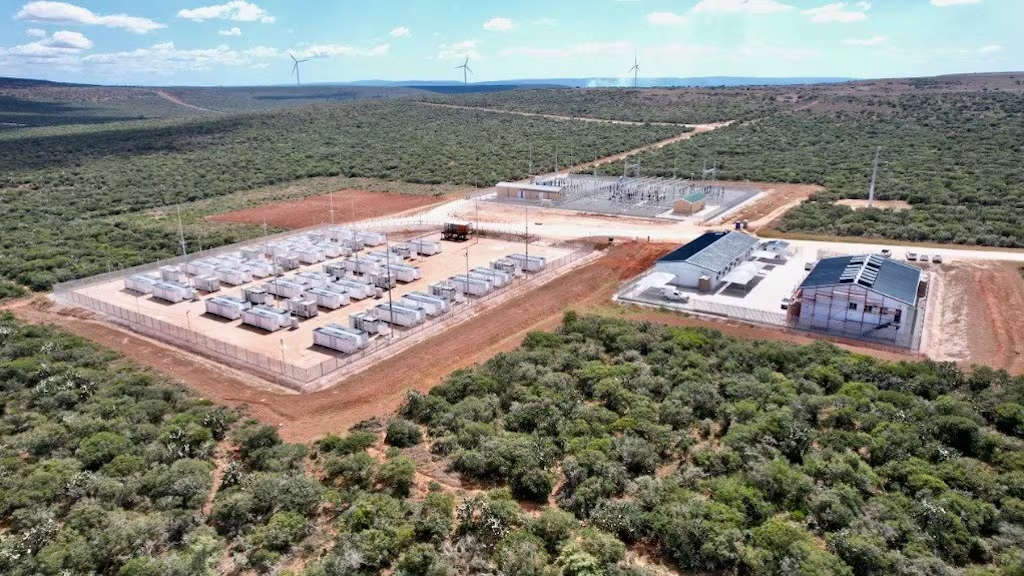
Developed by French renewable energy company EDF Renewables and funded by Rand Merchant Bank, the project combines solar, wind and battery storage technologies to offer dispatchable and reliable power to the national electrical grid. Umoyilanga will operate as a virtual power plant, combining generation from two sites which are 900km apart.
The next step is demonstrating that individual homes can operate as part of a coordinated electricity system.
Plentify’s Project Smart Solar is currently recruiting around 280 homes and businesses in eThekwini to coordinate rooftop solar, battery storage and electric geysers in what will become one of South Africa’s largest residential VPP demonstrations.
Although results are not yet available, Kornik said homeowner interest has been encouraging.
Countries such as Australia, Germany, the United States, Japan and Norway have already deployed commercial VPPs to balance electricity demand, integrate renewable energy and reduce pressure on ageing grids.
Norway, in particular, offers lessons for South Africa.
Svein Jørgen Sønning, chief commercial and technology officer at NODES, an independent, technology-driven marketplace that enables grid operators and energy providers – including VPPs – to trade decentralised energy flexibility, said regulators should not wait for perfect policy before testing the technology.
“One of the most important lessons is to start with practical initiatives rather than waiting for a perfect regulatory framework,” he told Oxpeckers.
Norway now allows commercial aggregators to combine flexibility from buildings, batteries and industrial facilities before trading those services into electricity markets. Distribution companies increasingly use this flexibility to manage network congestion instead of immediately investing in expensive grid upgrades.
“The results have been positive and encouraging,” Sønning said.
Eskom sees opportunity – and limitations
Eskom believes VPPs could become an important part of South Africa’s increasingly decentralised electricity system.
Responding to Oxpecker’s queries about VPPs, the utility said coordinated distributed energy resources could reduce peak demand, improve grid flexibility and support system stability.
By shifting electricity consumption away from evening peaks, VPPs could reduce reliance on expensive diesel generation while making better use of daytime solar production.
Eskom said it is already preparing its networks for growing numbers of rooftop solar systems and batteries through smart metering, improved network monitoring and continued registration of small-scale embedded generation customers.
However, the utility cautioned that VPPs cannot replace new infrastructure.
“They may help defer some infrastructure investment by reducing peak demand and making better use of existing resources. However, they are not a replacement for the new generation and transmission infrastructure South Africa requires to meet growing electricity demand,” Eskom said.
The utility also identified several technical challenges before VPPs can scale, including visibility of distributed energy resources, voltage and frequency management, cybersecurity and compliance with grid standards.
The regulatory gap
Energy analysts agree the technology is largely ready, but the policy framework is not.
Nicholas van Doesburgh, an energy analyst at Meridian Economics, said South Africa has already experimented with VPP-like programmes through Eskom’s demand response initiatives and municipal ripple-control systems.
“The biggest challenge now is creating a regulatory framework that lets VPP operators participate in the future wholesale electricity market and provide flexibility services,” he said.
Francis Jackson, founder of energy technology company Enerchy, said VPPs could unlock enormous value from infrastructure that households have already paid for. He compares the concept to “a stokvel for electricity”, where many small contributions combine into a resource large enough to support the national grid.
Jackson warned against allowing any single technology provider or utility to dominate the market.
“Owners should be free to choose their VPP operator and to switch, in the same way that your choice of cellphone network is not dictated by the brand of your phone,” he said.
Policy still catching up
Despite growing industry interest, South Africa has yet to formally recognise VPPs in its electricity regulations.
The National Energy Regulator of South Africa (NERSA) told Oxpeckers that VPPs currently have no official regulatory definition or licensing category.
While existing provisions governing electricity traders and aggregators may accommodate some VPP activities, there are still no specific rules governing how such platforms should operate.
Key questions remain unresolved, including how households and businesses should be compensated for providing flexibility, and who should own and regulate the customer data these platforms generate.
NERSA said it is monitoring international developments and engaging stakeholders but confirmed that no VPP-specific regulations are currently being drafted.